‘Technology is the easy part’: Washington, D.C., turned to collaboration, data governance for America 250
A number of major events and America 250 celebrations drew crowds to the nation’s capital over the weekend, but strategic communication and data-driven decision-making between Washington, D.C.’s technology office and Homeland Security and Emergency Management Agency kept operations running smoothly.
Beyond the gargantuan and sweltering celebrations for America’s 250th Independence Day celebrations over the weekend, as well as the White House’s Freedom 250 celebrations and fair, Washington D.C.’s summer season has also played host to nonstop festivals, free outdoor concerts, cultural parades and night markets. While Washington is no stranger to managing multiple events simultaneously, Clint Osborn, director of the city’s Homeland Security and Emergency Management Agency, or HSEMA, said July’s slate of events was, in a way, unprecedented.
“This summer is unique in that we are doing them all packed into a really tight window from May to August, and the number of different events that are happening also happen to have a lot of overlapping and touching footprints,” Osborn said. “It activates the entire downtown core for a really long window of time this summer in a way that we would usually build up, break down, build up, break down.”
Technology, Osborn said, is the “easy part.” Instead of treating the events one-offs, his agency is thinking about them as an extension of its long-running emergency preparedness. Stephen N. Miller, the district’s chief technology officer agreed, adding that each event, considered individually, isn’t all that different from past events the city has supported.
“The technology all remains the same,” Miller said. “It’s just the practice that we’ve had with everything going back from the coordination around the inauguration, what we went through last year with the Fourth of July. … The capabilities are better because the technology has matured, but we treat it like every other year, right? We’re still practicing, we’re making sure that everything is ready, that the data is available, shared and documented, that the systems are responsive and resilient. So, for us, it’s a definitely a big event, one that’s going on for a long time, but it is just practicing what we’ve practiced for years.”
‘A district enterprise’
Miller added that with so much practice, the network, security and data systems supporting the events — and even the district’s Office of the Chief Technology Officer, or OCTO — are designed to be invisible.
For communications, OCTO provides support for an opt-in text messaging platform operated by the district’s emergency management agency, called AlertDC. Residents can sign up to receive alerts from HSEMA and the Federal Emergency Management Agency, and wireless carriers can push out emergency alerts.
Both HSEMA and OCTO also partner with FirstNet, the federal communications network operated by AT&T. Through the partnership, devices and temporary cell boosters are placed strategically around the National Mall to extend wireless capacity for first responders and the public.
Osborn added that ensuring redundancy of these systems is a priority for HSEMA and OCTO, which is why they use a planning methodology called PACE — requiring a primary, alternate, contingency and emergency plan — for communications, infrastructure, networking and security, ensuring that no single point of failure can disrupt operations.
“That PACE planning that we’ve really been championing as a district enterprise … has really begun to like sort of infuse all of our thinking across all of our agencies’ work,” Osborn said. “That’s really the goal: that continuity is built into everything we build. You can’t build an application that isn’t sort of disaster-ready and a little bit crisis-proof.”
Investing in maps
The strategic coordination across district agencies wouldn’t be possible without OCTO’s continuous network and security operations services, which relies in part on artificial intelligence. The city uses AI in its cybersecurity work, as well an automated bot on the front-end of the city’s 311 service that handles initial call triage and routing.
From these tools, the agency can aggregate performance data from 73 call centers across the area to intelligently support and monitor the tech as well as the staffing for its support during big events.
Much of the interagency collaboration, however, happens on the OCTO-managed data platform, which includes thousands of open and internal-only datasets. While the city has Open Data DC, a platform with more than 1,000 records available to the public, Miller said there are thousands of other internal sets that agencies can access through the OCTO-managed platform and use them to aid in decisions.
For situational awareness and public communications, Osborn and Miller said they rely heavily on Esri’s ArcGIS mapping platform, including a map that will be used all summer long that includes layers like event footprints, plots of 911 and 311 calls, facilities and infrastructure.
“We’ve worked a lot, we’ve made investments in that [Esri] platform to make sure that people are getting quick service out of it,” Miller said. “We’ve reduced latency for our partners that are using it. We’ve increased training and awareness. We’ve centralized agencies into that platform. This was deliberate work making sure that more people understood the Esri platforms available, what it can do and increasing the capabilities and performance of it.”
Washington’s JIC
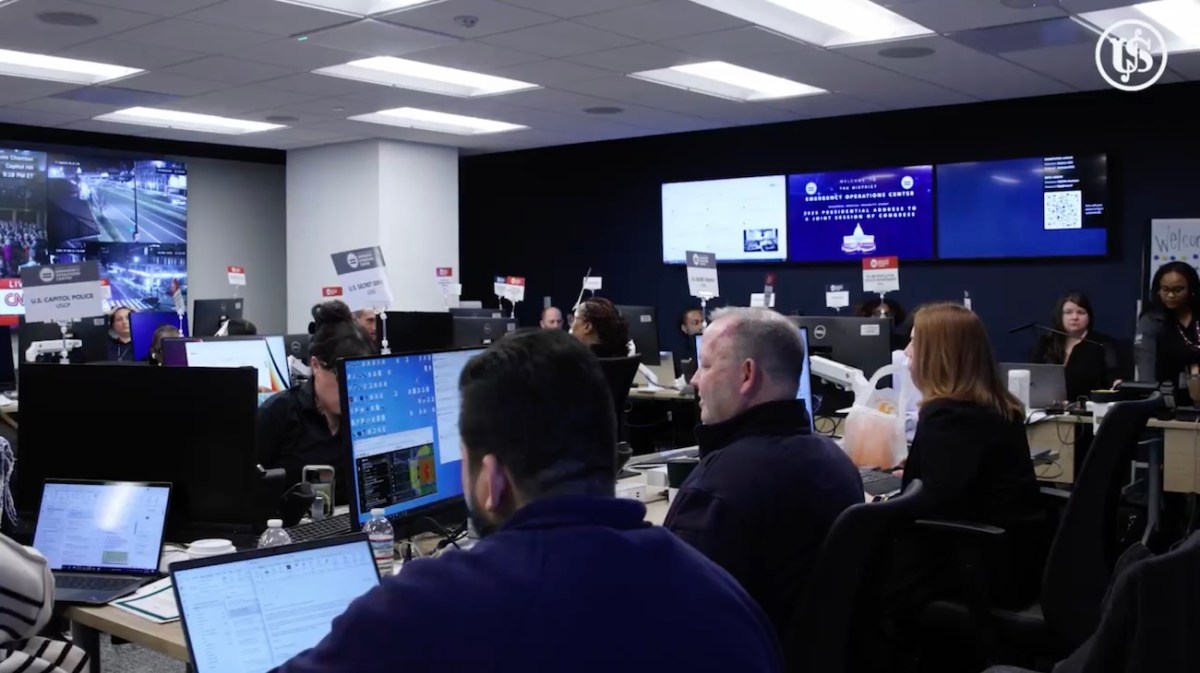
All of the agencies’ data sources can be fed into the city’s Joint Information Center, a physical office within the city’s Emergency Operations Center, that’s used by local, state and federal partners during emergencies and special security events. For this summer’s events, the JIC has helped turn all of the district’s official communications channels — agency sites, social media, media outreach — into a single, coordinated voice, an especially critical function when misinformation, infrastructure failures or life-safety issues are in play.
“We have to establish a message somewhere, and then all of our official sources have to reflect that message, and that for this summer, that’s 250.dc.gov,” Osborn said of a new website for Independence Day celebrations. “From there, you can get to a lot of other sources of D.C. government information.”
And when the JIC is not activated, the offices can lean on the district’s 24/7 Emergency Operations Center, the hub that Miller said is “always on,” aggregating data from 911 calls, utility impacts, network status and other sources. To ensure continuity, Osborn said, OCTO has embedded some of its members in the center, during normal business hours.
“Our goal is to have a single room that is always looking at all of the operations of district government all the time. We’re aggregating information from all sources, including social media,” Osborn said. “We’re taking in 911 call data, and we’re mapping that, and we’re looking at utility impacts. We turn to the right, and we look at OCTO’s team, and we say, Hey, are any of our buildings running on battery backup? We’re one of a handful of cities in the country that can say our emergency operations center is open 24 hours a day.”
The emergency operations center also powers “Watch and Warn,” a citywide system that provides real-time notifications for severe weather, traffic, crime and public safety threats. It’s a service HSEMA provides with support from OCTO, also 24/7, and operates through the AlertDC text channel.
While the city’s technology provides a common operating picture, Osborn and Miller said the real advantage comes from the people behind the systems, who have spent years building the relationships and routines that make rapid coordination possible — especially when life-safety issues are on the line.
“Everyone else can be fast, we have to be right,” Osborn said.
But, according to Miller, that standard is only achievable because they’ve put the relationships and coordination in place before an incident occurs.
“If something were to happen, we already know each other — we know who to talk to. We have all the right people in the right places within our Emergency Operations Center, within our Joint Information Center,” Miller continued. “Everything is set up, and the same people are there for the last six months, or six years in some cases. So, yeah, it’s knowing each other, trusting each other. It’s all kind of built into our routine at this point.”