Utah governor announces ‘pro-human’ AI plan, condemns federal preemption scheme
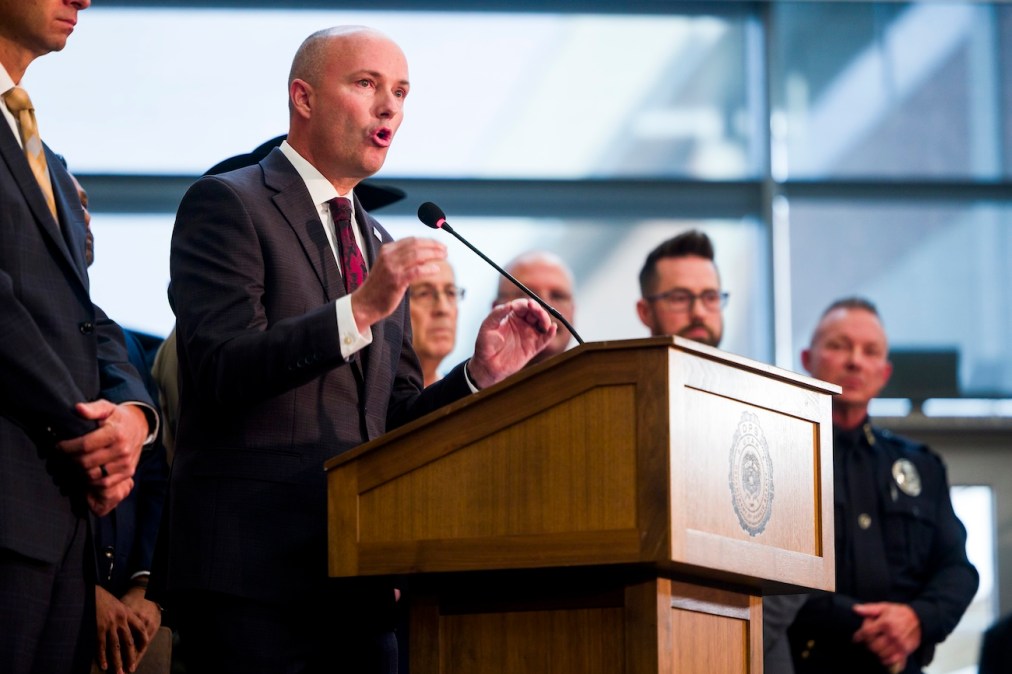
Utah Gov. Spencer Cox on Tuesday announced plans to kick off a “pro-human” AI initiative that will see $10 million spent on ensuring Utah’s workforce is “AI ready.” It also includes expanding AI across the state government.
During his announcement about the AI initiative, made at the state’s first AI Summit, hosted by the Utah Department of Commerce in Salt Lake City, Cox said the effort would span across the state, and involve private industry, state government and academia, along with public policy, learning and workforce sectors. Cox said the state will lead a “pro-human AI academic consortium,” The Salt Lake Tribune reported, that will “drive breakthroughs in human-centered innovation and advance human flourishing.”
Cox said the $10 million will fund development of state curriculums for higher education institutions and K-12 schools to bolster the state workforce’s AI readiness. The “pro-human” element of the plan, Cox said, will be derived from this investment in residents, the state’s workforce, and ensuring the technology stays “adaptable to human needs, rather than the other way around.”
Cox also criticized the federal efforts to preempt state and local regulations on AI. He said that while he disagreed with state regulations that inhibit innovation, states should retain the right to legislate protection from technology’s harms.
“The government should not be regulating the development of AI, but the minute you decide to use those tools to give my kid a sexualized chatbot, then it’s my business, and it’s the government’s business,” Cox said. “And Congress should not be stopping us from being able to do that.”
Federal lawmakers have made repeated attempts in recent months to tuck provisions that would preempt state AI law enforcement. One such attempt would have included it in the National Defense Authorization Act. Most recently, it’s been rumored in Washington that preemption might first be bundled with child online safety legislation.
The efforts have illustrated just how contentious of an issue the measure is among not only Democrats, but Republicans, too. President Donald Trump has advocated for the moratorium, and recently floated a draft executive order, while several prominent Republicans, including Rep. Marjorie Taylor Greene, from Georgia, Arkansas Gov. Sarah Huckabee Sanders and Florida Gov. Ron DeSantis, have spoken against the idea.
Cox’s remarks are also in line with the desires of hundreds of state lawmakers around the country, including a dozen in Utah, who last week who authored an open letter urging congressional leaders to strike down the AI preemption provision.
“I would much prefer that we have a Congress that can actually pass a bill, that could actually do something, that could function the way it was designed to function,” Cox said Tuesday. “But if it is not going to function, then the states must act, and we must have the ability to do that, and we will fight for that ability to do it.”
Cox said that the state’s 2026 legislative session will bring a number of new AI regulations, both to prevent big tech companies from monopolizing AI, and to reduce harm caused by AI and social media.
“In this next session, and coming up, you’re going to see much more work with our state legislature,” he said. “We’re going to be looking at harm reduction in AI companions, transparency around deepfakes, and an upcoming study around data ownership and control more broadly, as well as the interaction with AI and health care.”