Bishop Paiute Tribe first in California to join state’s middle-mile broadband network
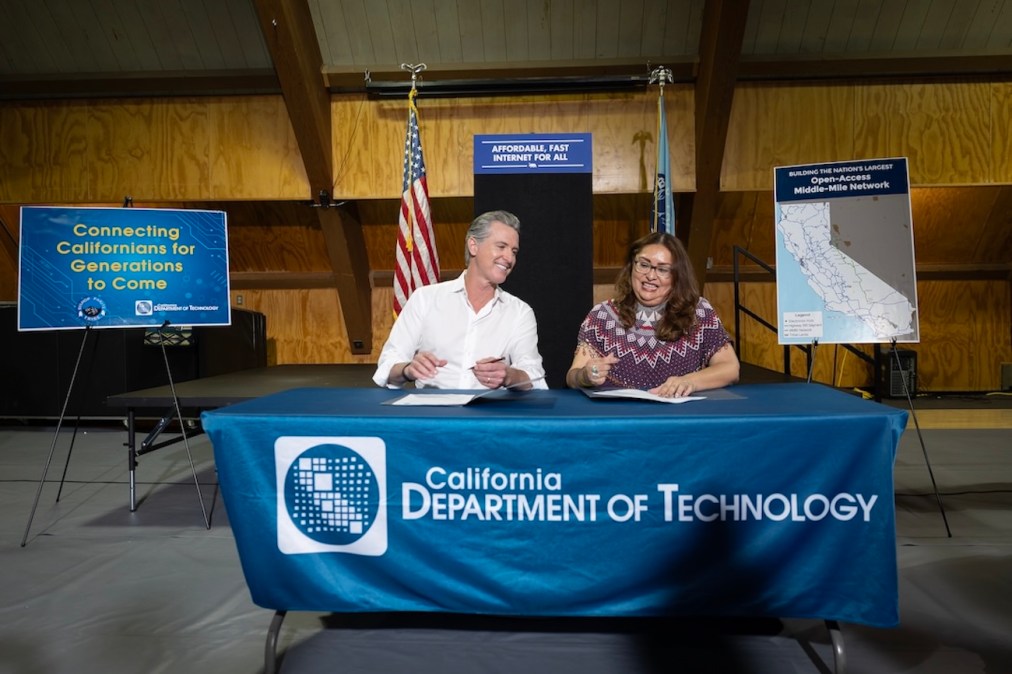
The Paiute Tribe of Bishop, California, on Thursday became the first group to connect to the state’s middle-mile broadband network when it linked its education and community centers.
Gov. Gavin Newsom joined the tribe for a switch-on ceremony honoring the first connection to the nation’s largest public broadband network, the California Middle Mile Broadband Network. The network was created in 2021 after he signed Senate Bill 156, which ordered the creation an open-access middle-mile network to bring equitable high-speed broadband service to all Californians. The law provided $3.25 billion to build the necessary infrastructure to bring internet connectivity to homes, businesses and community institutions — but specifically, to serve rural and historically overlooked communities, like the Bishop Paiute Tribe. Of the network’s more than 8,000 planned miles of fiber, the infrastructure linking the Paiute tribe was completed first.
Newsom, during remarks made at the live switchover event on Thursday, said the moment represented the first real-world impact of the nation’s largest open-access middle-mile network, and a major step forward in closing the digital divide across California, particularly for the tribe’s youth.
“This is the largest, there is simply no peer, the largest investment — over 8,000 miles … of infrastructure on the middle-mile. Nothing comes close in the United States,” Newsom said during a press conference following the network’s activation. “That investment alone is $3.2 billion dollars. The last mile, though, is where it all happens and that’s where the magic occurred quite literally just a few moments before we walked in. The magic wasn’t taking a small wire and plugging it in — it was to see those young kids [playing] Minecraft saying, Whoa, this is a little bit different than the game I was playing just a few moments ago.”
The network uses state infrastructure to support community self‑determination and autonomy. In this case, the Bishop Paiute Tribe signed a $0 contract with the California Department of Technology, which supervises the overall program and policy direction, for middle-mile broadband network services. The tribe’s internet service provider will set a pricing scheme and service models. This allows the tribe, not the state, to keep any profit from selling services.
The Pauite tribe’s new internet connection is on a previously dormant 423‑mile segment of fiber that runs along Highway 395 in eastern California — from Barstow to Reno, Nevada — purchased from the California Broadband Consortium. CDT updated the infrastructure by upgrading the fiber and constructing new huts, hubs and nodes to ensure the network could carry a healthy signal.
“A lot of work has gone into this project,” Emma Williams, chair of the Bishop Paiute Tribe said in a written statement. “We’re so happy to have this portion of the state’s middle-mile network turned on so the people in our community who desperately need a reliable and affordable internet connection can access everything from schoolwork to telehealth appointments.”
As of March, 423 miles were ready to connect, 4,827 miles were in the installation phase and the remaining 2,960 miles were in pre-construction. Those miles of fiber are being built and acquired through a mix of processes, including joint builds, leases, indefeasible right of use agreements and purchases. The network’s route has been determined in part by areas where private companies would likely never build because of the challenging terrain or the necessity of building long routes to attract relatively few customers.
Christina Snider-Ashtari, Newsom’s tribal affairs secretary said the day marked “a historic first as a California tribal nation enthusiastically leads the way to provide increased access and reliability to their local community. California’s partnership with the Bishop Paiute Tribe demonstrates the progress we can make when we work together to provide a brighter future for all Californians.”