Illinois weighs broadband access against farmland property rights

An Illinois bill aimed at easing property-access restrictions that are slowing federally funded broadband construction is drawing opposition from rural landowners and agricultural groups, who argue it infringes on property rights and could allow internet service providers to damage farmland.
The Broadband Deployment Act, introduced in February by Democratic state Sen. Patrick Joyce, would establish that qualifying broadband providers can use property within highway rights-of-way without obtaining individual landowner permission when building out networks funded by programs like the Broadband Equity, Access, and Deployment (BEAD) program. Under the legislation, ISPs would still be required to secure the appropriate right-of-way agreement or permit and follow notification and compensation requirements for the land usage.
It includes a sunset clause, meaning the legislation’s provision would expire Jan. 1, 2030, which is around when states are expected to complete BEAD-funded broadband deployments.
In many rural parts of Illinois, the authority that built the roads obtained only an easement for road use, rather than acquiring all the property rights in the roadway when it constructed the roads. As a result, farmland owners may still own the land beneath or alongside the road for uses beyond the road easement, which can often extend to the middle of the road.
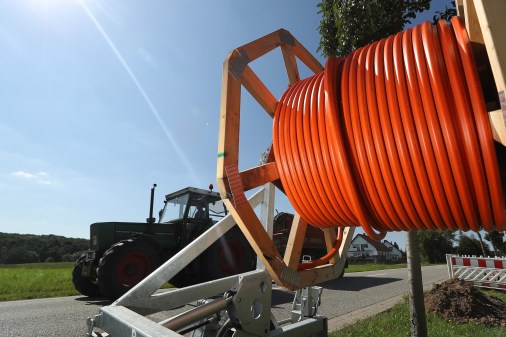
Installing utility infrastructure along roads in these areas, either along pole infrastructure or underground, can therefore require both an approval from the road authority and a separate easement agreement from the landowner.
When it comes to building out fiber networks funded by BEAD and other federal broadband programs, ISPs claim these right-of-way rules are making it difficult. Steve Schwerbel, director of state advocacy at the Wireless Internet Service Providers Association (WISPA), said that some of the providers his organization represents warned that if nothing is done, projects could face higher costs and delays — potentially making it impossible to finish within the four-year window or causing them to walk away.
Schwerbel estimated based on feedback from WISPA members that the impacted companies account for roughly 50% to 75% of Illinois’ allocated BEAD funds, since most of the funds went toward rural projects.
The Illinois Department of Commerce & Economic Opportunity (DCEO), which houses the Illinois Office of Broadband, told StateScoop that it supports the legislation. The office added that without some changes, the state could be sending some of its BEAD funds back.
“If enacted, the Broadband Deployment Act would accelerate broadband deployment statewide, ensuring communities across Illinois are connected to fast, reliable, and affordable internet. Without such legislation, many Broadband, Equity, Access, and Deployment (BEAD) projects may fail, resulting in thousands of Illinoisans being left unconnected,” said Eliza Glezer, assistant deputy director of communications at the DCEO. “The passage of this legislation is imperative to meet the required implementation timeline and without it, it is likely Illinois will be returning critical funding to the federal government.”
The Illinois Farm Bureau is on record as an opponent of the bill, along with the Illinois Railroad Association and the Illinois Broadband & Cable Association.
Bill Bodine, Illinois Farm Bureau’s director of business and regulatory affairs, told StateScoop that the bill was problematic for members because it would let broadband installers use a form of “quick take” eminent domain. This would allow ISPs to simply notify a landowner and install infrastructure without first negotiating an easement, while limiting the compensation the landowner could receive for the usage.
He also cited reported installation problems, including damage to underground farm drainage tiles that can cause water backup and crop loss, difficulty getting repairs completed and the installation of overhead lines that may not leave enough clearance for farm equipment. When asked about evidence of damages or which ISPs were responsible, Bodine said he would need members’ permission to share specific cases or photos of alleged installation damage.
Bodine said that the organization has offered solutions to this issue several times as its been an ongoing debate, but they have never reached an agreement with the broadband installers. He added that though the Farm Bureau supports broadband expansion and BEAD funding, the bill as written is a “step too far.”
“We’ve been supportive of BEAD, and in fact, are excited about the investments that will be made in the state of Illinois. Our members have long sought improved broadband services in rural areas,” Bodine said. “What we would like to see is that as BEAD is rolled out, it’s done in a fashion that respects the property rights of our members.”
Schwerbel noted that the next opportunity for Illinois lawmakers to advance the legislation will come during Illinois’ fall veto session, scheduled for Nov. 17-19 and Dec. 1-3. The six-day session gives lawmakers an opportunity to revisit legislation from the regular session. The timing could be significant for broadband deployment, he added, since Illinois only recently began contracting for its BEAD-funded projects after being the last state to receive federal approval of its spending plan.
“They’re right at the start of that six-month window to negotiate these contracts,” Schwerbel said. “Time is really important here for passing this bill if Illinois wants to make sure that their BEAD winners and state grant winners have the ability to to really build out these projects in a cost effective and timely way.”
Illinois is not alone in attempting to address regulatory and procedural barriers that could slow BEAD deployment. Oklahoma, for example, passed a 2023 law allowing certain existing utility easements and pole attachment agreements to extend to broadband infrastructure, while Idaho and Indiana enacted laws in 2025 aimed at improving utility pole access and resolving attachment disputes.
West Virginia has streamlined permitting requirements for certain infrastructure projects, while Michigan and Delaware have focused on improving coordination among state agencies and expediting permitting reviews.
At the federal level, Congress and the Federal Communications Commission have also explored ways to streamline permitting, including establishing deadlines for state and local agencies to approve construction applications and limiting permitting fees.
The Senate’s Accelerating Broadband Permits Act of 2026 has advanced to the Senate floor, with the chamber’s Commerce, Science and Transportation Committee formally reporting it Monday. It is sponsored by Sen. John Thune, the Republican from South Dakota who previously criticized the Biden administration’s handling of the BEAD program. It would require the NTIA to track BEAD project progress, help providers navigate permitting requirements and improve federal agencies’ compliance with existing deadlines for processing applications.
Separately, the FCC has proposed rules that would establish a 120-day deadline — or “shot clock” — for state and local governments to process certain broadband right-of-way applications and limit permitting fees to the government’s direct costs.
“It’s great to see the federal side working on it and it really is an important issue on the federal side — I’ve actually heard from a number of providers that NTIA has really been pretty helpful in getting permitting secured very quickly and knocking down hurdles where that’s been an issue,” Schwerbel said.
“As much as anything else, I think it’s going to be the local and state level permitting that remains a challenge because there are states or municipalities that see this as a great opportunity to bring broadband to their people, and then there are municipalities that see this as a great opportunity to shake somebody down for some more money,” he continued. “And obviously, I mean they’ve got potholes to fill and schools to fund and everything else, but it’s a challenging balance to get right.”