To fight fire, Southern California turns to sound waves, lightning-strike detectors
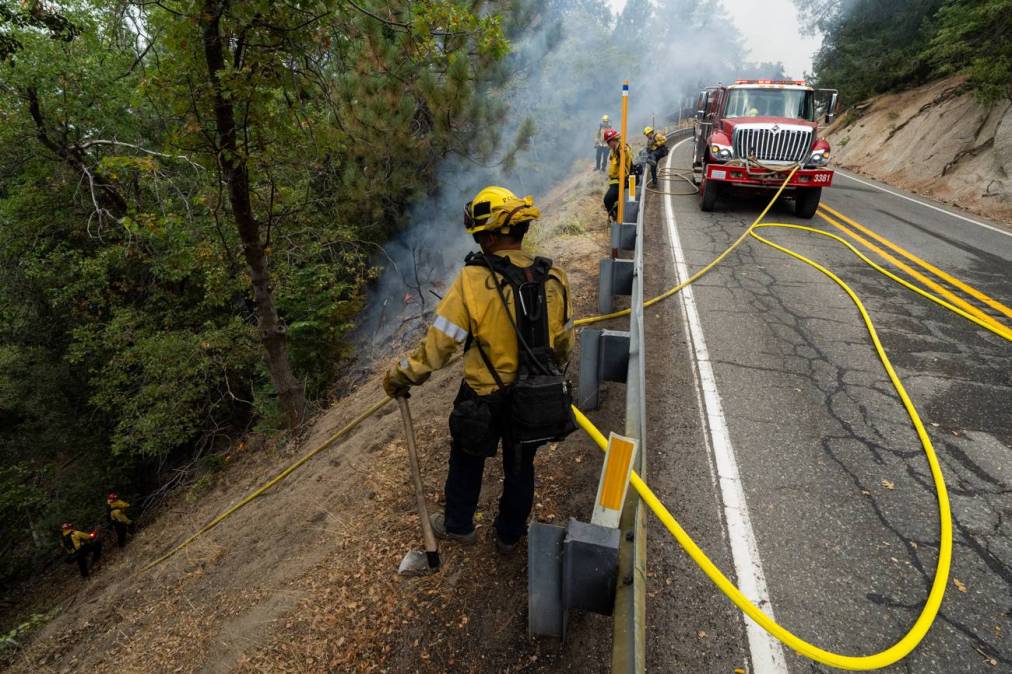
The fire department of San Bernardino County, California, is testing a new firefighting technology that uses low-frequency sound waves, rather than water or chemicals, to suppress flames.
The department, which serves a population of more than 2 million people in Southern California, performed a live demonstration on Monday, with the startup Sonic Fire Tech, of an “infrasound” system designed to disrupt the chemical reaction that sustains fire. The technology works by vibrating oxygen molecules, preventing combustion without removing oxygen entirely, which can create its own safety risks.
Officials said the system can create a protective zone capable of stopping ignition almost instantly, with potential applications ranging from structure fires to wildfire prevention.
“Developed by former NASA acoustics engineers, this technology works without water or chemicals, creating a protective zone that can stop ignition in milliseconds while avoiding the collateral damage often seen with traditional suppression methods,” the department wrote in a social media post about the demonstration. “This same technology can also be applied inside homes and businesses, helping stop fires like kitchen or appliance fires in their early stages before they grow and spread.”
A suppression method that does not rely on water could be significant in drought-prone regions throughout California. It could potentially be used in residential and commercial buildings, replacing or supplementing ceiling sprinklers, particularly in scenarios like grease fires, in which water can worsen conditions.
The pilot test comes as fire agencies across California face mounting pressure to adopt new tools for longer fire seasons.
In 2024, Gov. Gavin Newsom proclaimed a state of emergency to fast-track critical forest management and wildfire mitigation projects. Since then, more than 300 wildfire safety projects have been approved statewide.
Covering 20,105 square miles, San Bernardino is, geographically, the largest county in the contiguous United States.
Adam Panos, the county’s deputy fire marshal, said the county’s size, combined with a mix of densely populated cities, rural communities and vast wilderness, challenge emergency responders who must protect against earthquakes, floods and electrical fires. To stay ahead of potential wildfires that spark in rural areas, the department has deployed ground sensors from the startup FNN, or Fire Neural Network, that detect the heat signatures of lightning strikes. Recently, four such new lightning-detector sensors were installed, with more upgrades planned for the coming months.
“Let’s say it’s in the middle of the forest and nobody’s around,” Panos said in an interview. “It’s an uninhabited area where it would take a while for someone to see it from freeway, see the smoke column and report it. The whole idea behind early detection is it’s sooner than someone would be able to call 911. We’re picking [fires] up with ground sensing and remote sensing technology.”
Panos said the sensor network, integrated with Esri’s mapping platform, has reduced detection times for rural fires, aided in fire investigations and improved situational awareness during active wildfires, like the county’s 2024 Line Fire, a 110-day blaze thought to have been started by an arsonist.
Similar to sensors that can detect unique heat signatures, Panos said, the department also uses sound-detection sensors to analyze the unique audio frequencies emitted by fires.
“Fire can have a unique sound signature when it’s moving,” he explained. “[The sensors] use artificial intelligence and looks at just not what sounds but all the combination of sounds and uses that to detect the fire.”
While Panos acknowledged that no suppression tools or detection technology are completely foolproof, they are more effective when used together.
“None of these technologies predict a fire 100%, but when you have a combination of all the technologies combined into one common operating dashboard,” he said, “you can begin to see where you can verify one against the other.”