State leaders, civil rights groups respond to ‘dangerous’ Trump order banning state AI laws
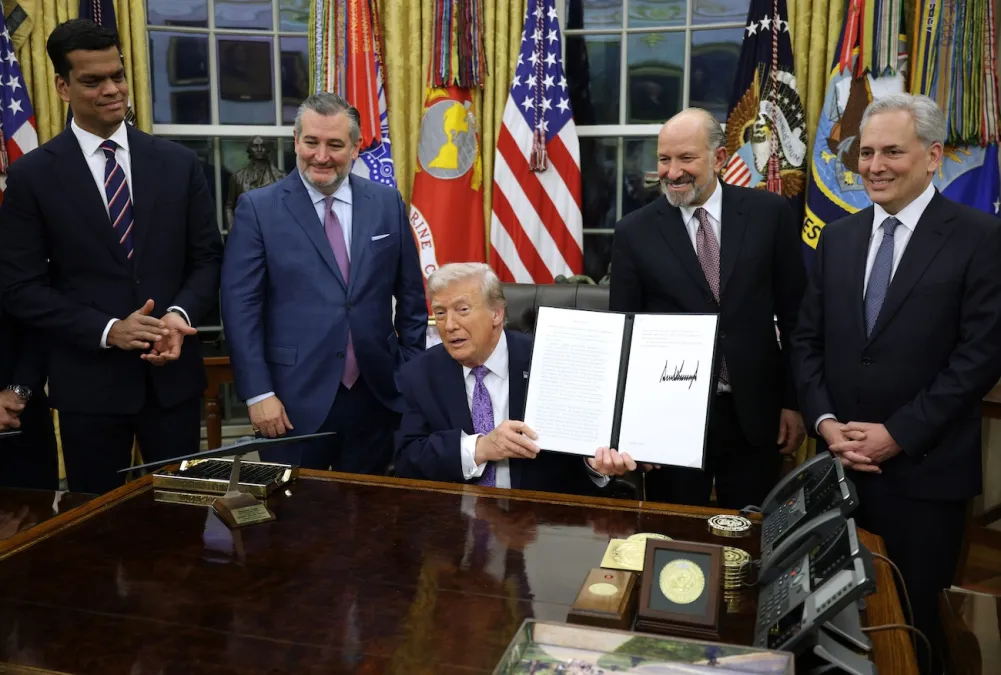
Following months of protest from state lawmakers, attorneys general and civil rights organizations, President Donald Trump signed an executive order Thursday evening banning states from enforcing their laws regulating artificial intelligence, potentially setting the stage for widespread legal challenges.
The order, titled “Eliminating State Law Obstruction of National Artificial Intelligence Policy,” closely follows a draft that circulated several weeks ago, with minor modifications. It aims to accomplish goals Trump laid out at the beginning of the week on Truth Social when he announced his intent to revive the measure after a number of legislative failures. It was dropped from the National Defense Authorization Act of 2026 earlier this week, and resoundingly failed in the federal legislature in July as part of Trump’s “One Big Beautiful Bill.”
The order seeks to help the U.S. maintain “global AI dominance” by curtailing “excessive state regulation” — but advocacy groups and state-level policy makers have said that without a federal framework to supplant the protections state laws have provided so far, this order will leave many exposed to potential harms like bias and discrimination, and that it hands Big Tech companies unmitigated power.
And while earlier proposals included a 10-year time limit on the state law ban, Trump’s order does not feature a fixed expiration date.
‘Impinging on interstate commerce’
Trump’s order calls out “onerous” laws like those in Colorado, a broad law that was the first to regulate high-risk AI systems in areas like hiring, lending, housing, insurance and government services. California has a slate of laws to address potential harms caused by AI deepfakes. Utah also has a cross-sectoral AI law on the books targeting AI’s use in the commercial sector.
“First, State-by-State regulation by definition creates a patchwork of 50 different regulatory regimes that makes compliance more challenging, particularly for start-ups,” the order reads. “Second, State laws are increasingly responsible for requiring entities to embed ideological bias within models. For example, a new Colorado law banning ‘algorithmic discrimination’ may even force AI models to produce false results in order to avoid a ‘differential treatment or impact’ on protected groups. Third, State laws sometimes impermissibly regulate beyond State borders, impinging on interstate commerce.”
Jake Parker, senior director of government relations at the Security Industry Association, a nonprofit trade group of companies that offer security and safety products and services throughout the U.S., lauded the order, citing a common point of support for squashing AI state laws. The group claimed that state AI laws impede innovation “by forcing businesses small and large to navigate a hodgepodge of inconsistent state measures.”
But many states, according to a report published in November by the Council of State Governments, undertook the work to legislate AI protections because of inaction from the federal government, with states and territories proposing more than 250 pieces of AI-related legislation in 2025 alone.
The National Association of State Chief Information Officers, a group that represents states’ top technology officials, released a statement opposing the proposal when it was first floated in May, noting it was “concerned” about its potential impact to the work states have done to regulate AI use in absence of federal laws. That same month, a national association representing 40 of the nation’s state attorneys general wrote in a letter that the measure was “irresponsible.” They noted that the historical lack of federal action has made state legislatures the default forum for addressing AI risks.
In June, more than 260 state legislators, from all 50 states, signed a letter opposing the provision in the federal budget reconciliation, lambasting it as “reckless.” Outside of industry boosters, bipartisan opposition to the concept has continued into recent months.
Withholding broadband funding
The president’s order also puts into limbo some funds states and territories were set to receive through the Broadband Equity, Access and Deployment program. The order directs the Commerce Department to withhold “nondeployment funds” states were set to receive under the program, should they continue to enforce their “onerous AI laws.” Nondeployment funds include remainder of state BEAD allotments that were Congressionally appropriated, originally designated for bolstering public services tied to broadband access, such as workforce development, telehealth, cybersecurity and digital literacy.
A bipartisan letter signed this week by more than 160 state legislators urged the Commerce Department to release to states their full BEAD allotments, including nondeployment funds.
Trump’s order directs National Telecommunications and Information Administration Administrator Arielle Roth to issue a new policy notice within 90 days “specifying the conditions under which States may be eligible for remaining funding.” The order instructs the policy notice to include descriptions of “how a fragmented State regulatory landscape for AI threatens to undermine BEAD-funded deployments, the growth of AI applications reliant on high-speed networks, and BEAD’s mission of delivering universal, high-speed connectivity.”
This potentially excludes states from accessing billions of dollars in funding, which the Trump administration has already indicated it plans to claim as “taxpayer savings.” The order also fulfills a key part of Trump’s AI Action Plan, which likewise featured a proposal to revoke broadband funding if the federal government found states’ AI laws to be overly “burdensome.”
‘Without regulation and oversight’
Many advocacy groups have denounced the order. Michael Kleinman, head of U.S. policy at the Future of Life Institute, a nonprofit research and advocacy group that promotes responsible management of technologies like AI and nuclear weapons, called the order a “a gift for Silicon Valley oligarchs who are using their influence in Washington to shield themselves and their companies from accountability.”
“No other industry operates without regulation and oversight, be it drug manufacturers or hair salons; basic safety measures are not just expected, but legally required,” Kleinman said. “AI companies, in contrast, operate with impunity. Unregulated AI threatens our children, our communities, our jobs and our future. … There is no democratic mandate for this kind of preemption by executive fiat, and American families and communities deserve better.”
American Federation of Teachers President Randi Weingarten called the order “outrageous and [a] likely illegal directive.”
Cody Venzke, senior policy counsel with the American Civil Liberties Union, called it “dangerous.”
“President Trump’s executive order doubles down on a dangerous policy that the Republican-led Congress has rejected not once, but twice: displacing states from their critical role in ensuring that AI is safe, trustworthy, and nondiscriminatory,” Venzke said in a statement, noting legal questions of the order’s directive to withhold already appropriated funds via BEAD.
“Moreover, the executive order is not just dangerous, it’s unconstitutional. The Supreme Court has made clear that the president may not unilaterally and retroactively change the conditions on federal grants to states after the fact. Each of those grants are an agreement between states and the federal government, and threatening to withhold funds for schools, broadband buildout, nutritional support, and more for unrelated AI policy fights will unnecessarily harm the American people,” Venzke continued.
Alexandra Givens, president and chief executive of the nonprofit Center for Democracy and Technology, said that the order points the finger at states, but does “nothing to address the real and documented harms these systems create.”
“States that take steps to protect their residents from such harms should not be subject to threats of legal attacks; nor should the administration punish rural Americans by threatening to withhold funding for the broadband services that could connect them to AI in the first place,” Givens said. “Only Congress can preempt state laws, and it has now twice correctly decided not to pursue this misguided and unpopular policy. State officials should not be deterred in their efforts to provide guardrails for AI.”
And while the order does not call out California, as it does Colorado, Sen. Alex Padilla, the Democrat from California, also criticized the measure, noting that it infringes states’ rights.
“No place in America knows the promise of artificial intelligence technologies better than California,” Padilla said in a statement. “It’s why we are world leaders in A.I. innovation and industry and why we have been able to work collaboratively to adopt some of the strongest consumer protections in the country. But with [this] executive order, the Trump Administration is attacking state leadership and basic safeguards in one fell swoop.”