Arizona’s new regional cyber center a ‘force multiplier’ for local governments, students

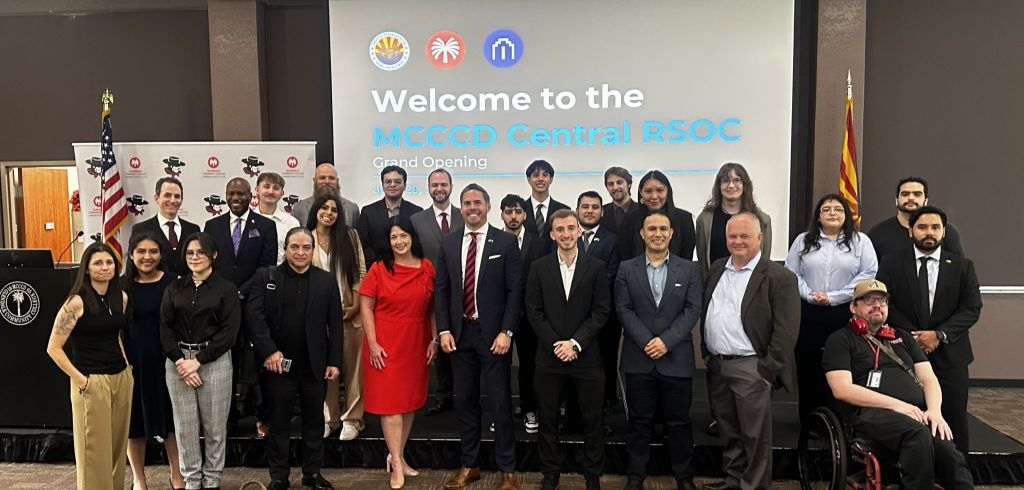
At the end of June, Arizona’s Department of Homeland Security announced the launch of the state’s newest regional security operations center. The state’s cyber leaders said it will serve as a “force multiplier” for local governments, school districts, tribal communities and critical infrastructure operators, while creating more workforce opportunities for students pursuing careers in cybersecurity.
The Central Regional Security Operations Center operates out of both the Glendale Community College in Maricopa County and the Paradise Valley Community College in Phoenix. The center, which is the second official RSOC in Arizona, is an extension of the Arizona Cyber Command. The two locations are student-run cyber defense hubs, providing services such as monitoring, threat analysis, incident advisory and cyber threat intelligence to the state’s smaller and resource‑constrained government entities.
While elevating the IT security capabilities of smaller governments, the center also provides pathways for cybersecurity students to gain work experience through internships. That experience can help the students help land full-time jobs either in the public or private sector once they graduate.
‘Healthy, safe, legal fun’
Josh Kipers, the regional security operations manager for the new center, oversees all three of Arizona’s RSOC locations, all of them housed at community colleges. Before helping to build and expand the program, Kipers himself benefited from the state’s cyber-to-career pipeline. Kipers said he got into the cyber industry after a career change. He went back to school at Pima Community College in Tucson, where he interned at the college’s Center of Excellence in Information Technology and Cybersecurity and became a data center specialist. Through that role, Kipers said, he made industry connections, including with Ryan Murray, the state’s chief information security officer and deputy director of the state’s homeland security agency.
“[Murray] had talked about the vision of the RSOC to a lot of the leaders there, and Pima was like, Let’s start tomorrow, which was just kind of our mentality down there,” Kipers said in an interview. “Any opportunity we could take, we’re going to take it. And so I kind of switched my roles from breaking computers and servers and having a lot of healthy, safe, legal fun down there into becoming more defense engineering. From there, I was able to be selected as one of the first site leads for the RSOC project.”
Kipers was hired in January 2025 to begin building the regional SOC model and the first center at Pima Community College. He said the first site was fully operational by the following July. During those first six months, Kipers helped to define the workflows for the centers to pair interns with cyber professionals. He worked with advisory boards and state cyber leadership to shape training and maturity metrics. And he helped to lay out the RSOC’s goals and internal ethos, which include a culture of collaboration, hands-on training and an “ego-free environment,” he said.
“I think that there was a kind of a connotation around the word intern that I immediately wanted to kind of stay away from. They are interns, but they’re sitting in front of the threat, they’re protecting the communities, they’re working every day when they come in,” Kipers said. “They’re the ones that are looking at all of the detections that we’re seeing through our [application detection and response] platforms. They’re the ones who are doing the analysis, ingesting the cyber threat intelligence and doing the SOC analyst job.”
Arizona Gov. Katie Hobbs announced the state’s first RSOC at Pima Community College last November. Officials plan for there to be five RSOCs in Arizona by June 2029, with each serving a different region.
“The launch of the Central Regional Security Operations Center is a vital investment in our partnerships, preparedness, and shared mission to keep Arizona safe and resilient,” Kim O’Connor, the director of Arizona’s homeland security agency, said in an emailed statement. “The RSOC represents our collective effort to protect the state through collaboration. By sharing information, we strengthen our security and ensure that our partners can respond to threats faster and with greater confidence.”
In practice, Kipers said, sharing information means helping smaller governments expand their cybersecurity capacity without requiring them to build large security teams of their own.
“We really try to provide a force multiplier, … being able to provide that force multiplier and give [smaller governments] that critical insight and up-to-date communication is one of the challenges that we’re hoping to pull away from them,” he continued.
More eyes
Eduardo Varela, the south RSOC’s site lead contractor at Pima Community College, charted his path to the role by initially working as an RSOC intern. He said that the hands-on work through the internship and learning from the RSOC’s leadership was “worth so much” and couldn’t be replicated by classroom-only training.
Along with that experience, which he said allowed him to understand the program from both the entry level and managerial sides, a key part of his job is to work directly with IT professionals across the smaller governments. He said having that close contact with customers, and insight into their struggles with cybersecurity, enables him to help better target services.
“Sometimes they’re just really small teams, so to have another pair of eyes constantly viewing into what could be possibly happening in their environments, it provides a lot of insight,” Varela said. “Sometimes it could just be someone who’s an IT professional, but not necessarily cyber-oriented. So to be able to provide a cyber perspective into what they’re seeing is absolutely something that we provide.”
Beyond providing an extra layer of support for local agencies, Arizona officials said the state’s regional security operations centers have strengthened communication across the state’s entire cybersecurity ecosystem, be it the public or the private sector, in terms of services and workforce.
“Now that we have these regional SOCs, we have our site leads and our cyber interns are able to connect with these communities and bridge the gap between what the state is doing and what the smaller regional areas are doing as well, and that creates a flow of communication where we’re able to share resources and knowledge and cyber threat intelligence very quickly across all facets of what we do,” added Kipers, the new center’s regional security operations manager.
Arizona is not the only state to run regional security operations centers out of its higher education institutions. UC Berkeley researchers recently found that Texas, Louisiana, Oregon and South Carolina also each run at least one RSOC out of a community college or university. Other states have established similar college-to-career pipelines. An internship program in North Carolina gives cybersecurity students the opportunity to also participate in training in cyber roles at the North Carolina Department of Information Technology.
“My success story would be to see it across other states,” Varela said. I would love to see it become standardized, and other states sharing with Arizona and vice versa,” “Like, Hey, this is what we are doing within our RSOC model. Are you guys also doing this? Or, Is there anything that you guys could provide feedback on?“
Kipers said he also wants to see the model grow beyond just a handful of states.
“That would be the greatest thing to hear,” he said. “That this is something that people want to do and it works and it makes professionals, and it’s making a better future for the United States.”