How do California’s gubernatorial candidates stack up on AI & tech policy?
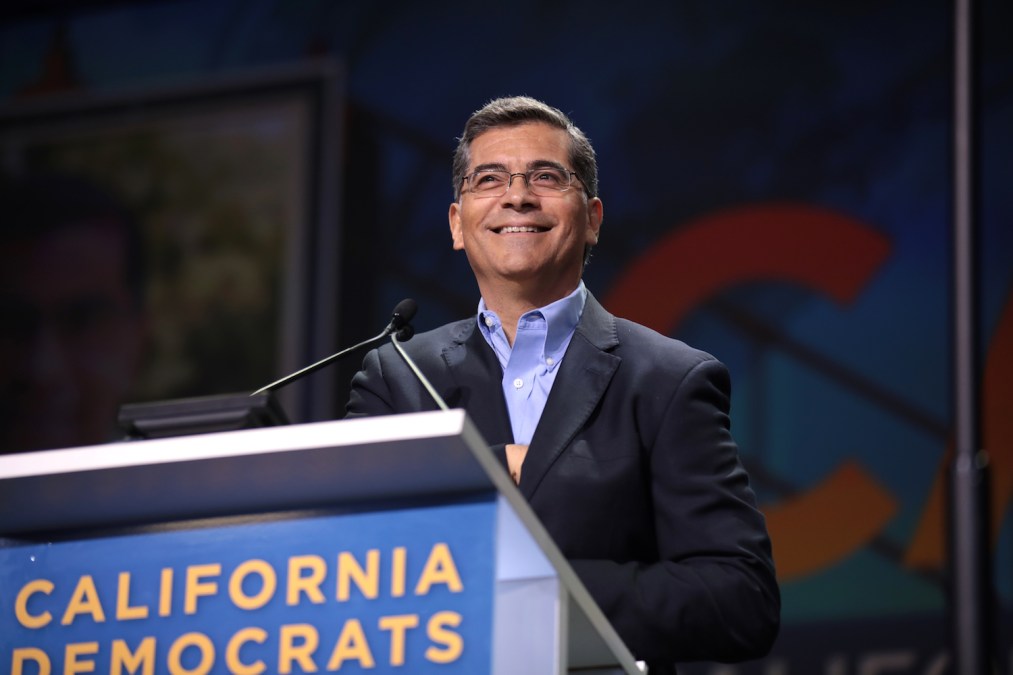
As California voters weigh who should lead the nation’s largest state, technology policy is emerging as one of the clearest distinctions between gubernatorial candidates Xavier Becerra and Steve Hilton. The state’s next governor will oversee the state’s sprawling IT operations, cybersecurity defenses, AI governance efforts and digital services used by nearly 40 million residents — in addition to one of the world’s biggest technology economies.
The November election for governor will arrive as California continues expanding its use of generative artificial intelligence across state government, strengthening cybersecurity requirements, modernizing legacy technology systems and investing in digital tools for everything from wildfire response to public benefits. For state and local IT leaders, the outcome could shape everything from AI procurement rules and cybersecurity investments to digital service modernization and workforce priorities.
Xavier Becerra, the 68-year-old Democratic nominee — and former the state Attorney General and U.S. Health and Human Services Secretary — advocates for a government-led approach that pairs AI adoption with regulation and worker protections. He’s argued in his campaign that California should use artificial intelligence to improve services such as permitting, benefits delivery and public health, while maintaining transparency, human oversight and stronger safeguards around automated decision-making. Becerra has also proposed expanding AI literacy, funding public AI infrastructure through CalCompute and strengthening enforcement of California’s AI safety laws.
Steve Hilton, the 56-year-old British television host and Republican nominee, has centered his campaign on shrinking state government and reducing regulation, arguing California’s technology sector has been stifled by bureaucracy. He plans to create a California version of the federal Department of Government Efficiency, streamline permitting, modernize government operations and make the state more attractive for technology investment.
In an interview, Bahrad Sokhansanj, a senior research scholar at the Institute for Law and AI, an independent think tank, noted that while both candidates say technology should help improve government performance, they offer markedly different visions for how much government should regulate emerging technologies versus relying on innovation and market competition to drive change.
Sophia Fox-Sowell: Both Becerra and Hilton’s campaigns seem focused on AI implementation, deployment and regulation. What are California’s biggest AI issues?
Bahrad Sokhansanj: AI is this transformative technology, it’s affecting the way we work, it’s becoming more deeply embedded in the way we live. There’s Claude or ChatGPT, there’s AI that generates videos, there’s AI that generates images — people are anxious about increasingly powerful AI. California is where a lot of the AI companies are based, so there’s kind of a tension between people who care about the effects of AI, but AI is also a driver of the state economy and increasingly, a driver of the state’s tax base. California relies a lot on income from capital gains taxes. When stock prices go up and when AI companies are contemplating initial public offerings, that’s a bunch of money that comes into California’s tax base and helps fund all the programs that California wants to have. So in terms of AI, California uniquely cares both about being the place where AI companies are located as well as a place where people are being impacted by AI in their lives.
Is public sentiment a factor when it comes to the candidates’ positions on AI? Are these two candidates tailoring themselves and their platforms to keep up with voter opinions?
Both of them talk about some things that people are anxious about, like kids’ safety, but I think a lot of people are now very worried about data centers. I think there was a very notable result in Monterey Park, where they had a referendum with 87% of voters in favor of a data center moratorium. This is increasingly becoming a big issue and yet, if you look at the platforms, Steve Hilton says we should make permitting for data centers easier. He wants to encourage the infrastructure as a source of jobs. Xavier Becerra says the same thing, that we need to have a predictable regulatory policy for data centers. Becerra’s main focus is on making sure they pay for their energy costs, but they’re both very much oriented towards how to build more data centers, whereas we’re seeing public sentiment really shift against that from both parties. But their platforms don’t really address what seems to be the big thing that people care about and a big source of opposition. It’ll be interesting to see if the campaigns evolve or change over the next few months on that issue, because I’m sure it’ll come up.
I feel like it is a question on everybody’s mind these these days, and there’s an even split between those wanting data centers built for jobs and infrastructure versus those against it because they’re worried about the environmental impacts.
Whenever I say I work in AI policy, people always bring up data centers.
California is such a hub for technology and innovation, but other states also look to it for regulation and policy frameworks. Do you think Xavier Becerra and Steve Hilton are trying to contend with how to balance AI innovation with regulatory practices?
I think both of them are very conscious of this. Compared to other states, California has a lot of regulatory capacity. It has a well-resourced state government. Not all states have that. It has a full-time legislature, people not making $5,000 a year and need another real job, right? They are legislators first and foremost — people often underrate that, but that actually makes a difference. I think both candidates have really taken that into account, but of course they differ in terms of the degree of regulation. Steve Hilton calls his platform, “Let’s keep California the AI capital.” Xavier Becerra has also said he wants AI companies to stay in California. Though Becerra’s platform has more proposals for regulation than Steve Hilton’s platform, he is also clearly taking into account the fact that he doesn’t want to drive companies out. We’ve seen Oracle leave, X relocate, so there’s an awareness that other companies could also move out. The state brags about being the fourth biggest economy, but these are the companies that are making it the fourth and fifth biggest economy.
California has already launched its proprietary AI assistant, Poppy and signed an agreement with Anthropic to use its AI assistant, Claude, at a discounted rate. Xavier Becerra has suggested how the government can use AI to streamline its services, whether it’s with the permitting process or housing applications, but I haven’t seen Steve Helton talk about how the government itself should adopt AI. What do you think that shows in terms of priorities between the two candidates? Is there a difference there between just focusing on the private sector and economic growth versus how this technology could be beneficial to the government as well?
Steve Hilton’s platform is much more focused on reducing red tape and reducing the scale of bureaucracy, so that’s where he has emphasized changes that he would make to the current status quo. Whereas, I mean, perhaps to be expected, Xavier Becerra is much more focused on how we actually make government work better — although he does talk about streamlining some regulations as well. It’s quite possible that if you ask Steve Hilton, he would say, “I think that’s a good idea too.” It’s just something that may not have come up.
We talked about data centers, but what about bias in decision making? The Democratic platform seems to be making sure AI is developed safely and ethically, whereas Republicans are more focused on cutting through bureaucracy and just getting to the finish line. Do you think these candidates are leaning into their national party standards?
I don’t think it’s necessarily true anymore that Republicans at a national level are purely focused on just cutting through red tape and simply developing it with fewer safeguards. I think you saw that with the what the White House did over Anthropic’s Fable and the discussion around a national preemption against state AI laws. At the national level, there are some Republicans who are very deregulatory and say we shouldn’t have regulations on AI. There are other Republicans who are very concerned about kids’ safety, about political bias. In Florida, the attorney general sued ChatGPT and OpenAI. So I push back a little against there being that much of a dichotomy. Also, I would point out that in Becerra’s platform, he is talking more about transparency as his response to bias. He’s not saying we shouldn’t have bias, but that we should be transparent about the potential source of bias when a decision is made.
I see what you mean. Are there other differences between their IT policy perspectives?
The attorney general is very important in terms of regulating these things, and there’s talk about Xavier Becerra’s record when he was the attorney general, how aggressive he was against tech companies or how aggressive he wasn’t — some of that came up in the primary. Attorney General Rob Bonta has been very aggressive in terms of wanting to stand up AI oversight. He is enforcing a lot of laws that are already on the books, so the governor has a chance to veto laws or to encourage the legislature to pass certain laws. Ultimately, Bonta, if he’s re-elected as attorney general or the Republican candidate is elected, they’re going to be responsible for enforcing both the laws that already exist and any new laws that are passed. They’re the ones deciding whether to join a lawsuit against the federal government or a lawsuit against one of the big companies. They have a lot of power here, so it’s important to pay attention to what they’re doing in addition to the governor’s agenda.
How do you think it will it affect policy and enforcement if the governor and attorney general are the same political party, versus different parties?
There can be differences around budgets that people pass and whether a governor doesn’t like the amount that’s being funded for enforcement, but really it becomes more of a political contest. Because you may have a tension between an attorney general and a governor who don’t see eye to eye, and they might be from the same party too, right? Attorney generals are also ambitious people, too.
This interview was edited for clarity and length.